Keystone Trees
Why Oaks Matter
The Most Important Tree in Your Yard
I've spent my career around trees, and if you asked me to pick one to protect above all others, I wouldn't hesitate. It's the oak.
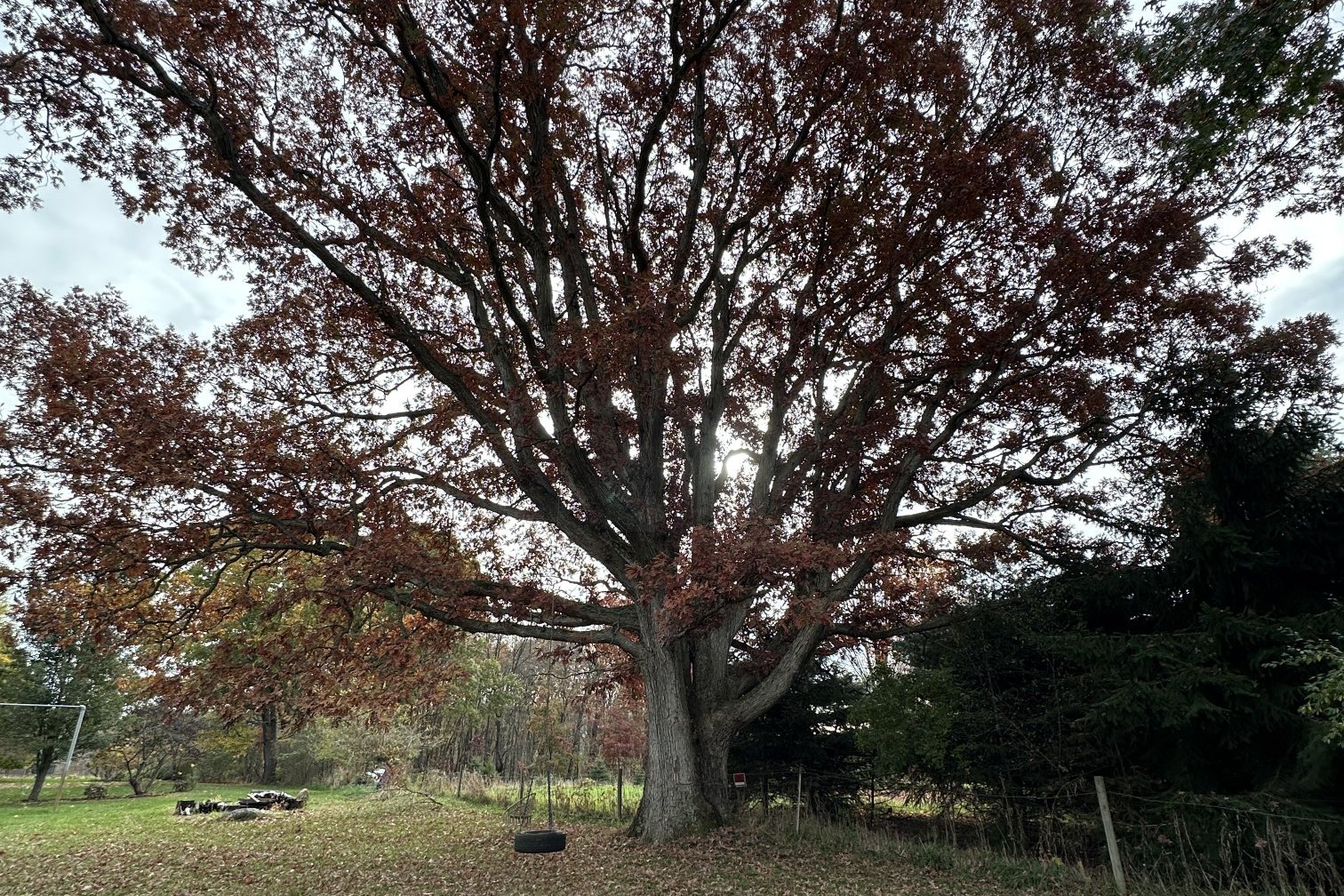
The tree that holds the neighborhood together
Not because oaks are the prettiest tree on the street, though a mature bur or white oak is hard to beat. It's because of what they do. An old oak is more than a tree. It's a living ecosystem, feeding and sheltering more life than almost anything else you could have in your yard. Lose it, and an entire web of life loses its anchor.
Much of what we now know about that web comes from one scientist whose work I believe every homeowner should know: Doug Tallamy.
The Scientist
Meet Doug Tallamy
Doug Tallamy is a professor in the Department of Entomology and Wildlife Ecology at the University of Delaware and a three-time New York Times bestselling author. For decades, his research has asked a simple question with huge consequences: what do the plants in our yards actually feed?
His answer changed how a lot of us think about landscapes. Birds depend on insects, and most of those insects, especially caterpillars, depend on specific native plants. Fill a yard with plants that local insects can't eat and it may look green, but it's close to empty as habitat.
And at the very top of the list of plants that keep that food web running stands the oak.
The Research
The numbers that stopped me in my tracks
900+
species of caterpillars feed on oaks in North America, more than on any other tree
96%
of nesting songbirds raise their young on caterpillars
6,000–9,000
caterpillars to raise a single clutch of chickadees
5% → 75%
about 5% of native plants produce 75% of the food caterpillars depend on
Scientists call the small group of native plants that do most of the work "keystone plants," and native oaks lead them all. A pair of chickadees brings a caterpillar to the nest roughly every three minutes, from dawn to dusk, for more than two weeks. Now picture that pair in your neighborhood. Where are they finding thousands of caterpillars? Very often, in an oak.
Tallamy puts it better than I can:
“If you plant a single acorn, it will support tens of thousands of individuals of thousands of species during the tree's lifetime.”
A Lifetime of Work
What an oak does over a lifetime
Caterpillars are only the start. Over the decades and centuries an oak lives, it:
- Feeds wildlife from the top down. Its leaves feed caterpillars, the caterpillars feed birds, and its acorns feed everything from woodpeckers that store hundreds of them to deer, turkeys and squirrels.
- Gets more valuable with age. A young oak is a promise. A mature oak is that promise kept, with a canopy, root system and wildlife value no newly planted tree can replace in our lifetime.
- Shapes the place we live. The big oaks in Southeast Michigan's neighborhoods are often older than the homes around them. They shade our streets, cool our homes and give a place its character.
That's why I take removing a healthy oak so seriously. It isn't one tree coming down. It's a whole community of life losing its home, and it takes generations to grow back.
Protecting Oaks
Why oaks need a little help
Oaks are tough, but they face real threats in our area, and most of them are preventable:
- Oak wilt. This disease can kill red oaks quickly, and it spreads through fresh wounds. That's why we only prune oaks during dormancy, when the tree is resting and the disease isn't spreading. I'm ISA Oak Wilt Qualified.
- Root zone damage. Construction, grade changes, soil piled over the roots and compaction from equipment quietly kill many mature oaks. The damage often shows up years later.
- Turf and soil stress. Grass right up to the trunk, raked-bare soil and heavy compaction starve an oak's roots slowly. We wrote about that in Your Lawn vs. Your Tree.
The good news is that a mature oak in decline can often be brought back with the right care: proper pruning, root zone restoration, mulch and a soil plan built on what the tree actually needs. That's the heart of our plant health care.
Your Yard
What you can do
Tallamy's message isn't just for scientists. It's for homeowners. A few things make a real difference:
- Protect the oaks you have. A mature oak is irreplaceable in our lifetime. Before any construction, grading or major landscaping near one, talk to an arborist.
- Give the roots room. Swap the grass under the canopy for a wide ring of mulch, and leave the leaves where you can. Leaf litter under an oak is habitat, not mess.
- Plant an oak. As Tallamy puts it, plant more oaks than ever. Choose a native oak suited to your site and give it space to become the tree it's meant to be.
- Add native plants. Every native planting adds to the food web. That's the idea behind Homegrown National Park, which Tallamy co-founded with Michelle Alfandari: planting native, removing invasives and restoring habitat where we live. You can put your yard on their map.
Go to the Source
Learn from Doug Tallamy
If this page sparks anything for you, go to the source. These are some of the best books ever written for homeowners who care about trees and wildlife.
The Nature of Oaks
A month-by-month look at life in and around an oak, plus practical advice on planting and caring for one. If you read one, read this.
Nature's Best Hope
How homeowners can turn their yards into a connected network of habitat.
Bringing Nature Home
The book that started it all, on why native plants matter.
How Can I Help? Saving Nature with Your Yard
His newest, a practical guide to getting started in your own yard.
And visit Homegrown National Park to see how many people are already doing their part, and add your own yard.
Caring for oaks is what we do
Preserving mature trees is the heart of our work, and oaks are the trees I'm proudest to protect. Our care follows the ANSI A300 standards and ISA Best Management Practices, and every pruning plan for an oak starts with timing, structure and the health of the root zone.
If you have an oak you want to keep for the next hundred years, let's take a look at it together.
Serving Novi and communities across Oakland, Wayne and Washtenaw Counties.