Certifications
The Hidden Costs of Hiring the Wrong Tree Service, and How to Choose the Right One
Trees are some of the most valuable and longest-lived things on your property. A mature shade tree took decades to grow and can't be replaced on any timeline that matters to you. So the person you trust to work on it matters more than almost any other contractor decision you'll make.
The tricky part is that bad tree work rarely looks bad right away. A tree that was cut badly still looks neat the day the crew leaves. The bill for poor work comes later.
What an ISA Certified Arborist is
The ISA Certified Arborist credential is a professional certification from the International Society of Arboriculture. To earn it, a candidate needs years of full-time, hands-on experience in arboriculture, or a related degree plus experience. They must then pass an exam that covers tree biology, identification and selection, soil management, installation and establishment, pruning, diagnosis and treatment, trees and construction, tree risk, safe work practices and urban forestry.
Certification isn't permanent. Certified Arborists must keep earning continuing education credits or retake the exam to stay certified, and every applicant agrees to ISA's Code of Ethics. It's a credential that has to be kept up.
The hidden costs of the wrong choice
- Work that weakens the tree. Topping and lion's tailing are listed as not acceptable in ANSI A300, the American pruning standard, and for good reason. Topping weakens and stresses a tree, and the regrowth is weakly attached and breaks off easily while the exposed wood often rots. Lion's tailing leaves a tree more prone to wind and ice damage.
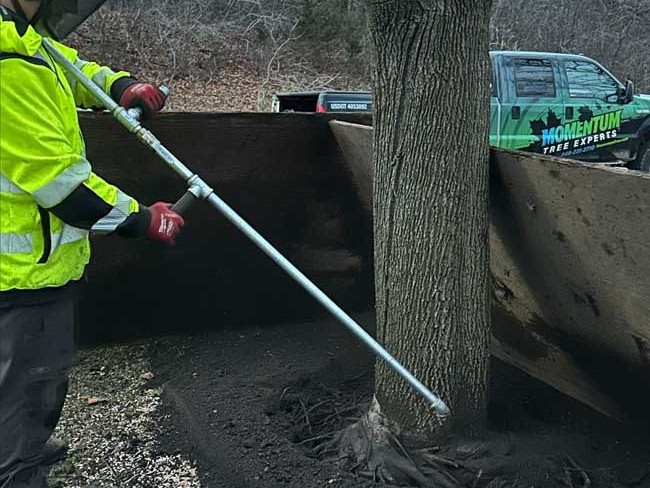
- Removing a tree that could have been saved. A struggling tree is not always a dying tree. We often find that the real problem is below ground. Compacted soil cuts roots off from water, nutrients and oxygen, which can cause crown dieback or even kill a tree, and because compaction is hard to see, it's easy to miss. A stressed oak that looks like a removal can turn out to need soil and root work instead. That's why we look at the soil and roots before anyone talks about removal, and why we offer plant health care, air spading and vertical mulching.
- Paying for the wrong fix. Work done without a proper diagnosis often misses the actual problem. You pay for it, and the problem is still there.
- Missed warning signs. Some serious problems are hard to see. Wood decay can be difficult to detect, and root defects are hard to identify without training. Catching them is a big part of what a trained arborist is for.
- Insurance gaps. If a crew without proper coverage damages your property, or someone gets hurt on the job, you can be the one left dealing with it. Before any work starts, ask for proof of liability insurance and workers' compensation.
A checklist for hiring tree care
- Ask for proof of certification and membership in professional organizations.
- Get insurance proof directly from the insurer. Ask for a certificate of insurance sent straight from the company's insurance agent, call to confirm the policy is current, and ask about workers' compensation.
- Get more than one estimate, but remember that skill, reputation and professionalism may matter more than a low bid.
- Get a written contract. It's the best way to prevent misunderstandings and make sure the work meets the standard you were promised.
- Check local references, look at work they've done, and talk to past clients.
- Be wary of door-to-door offers from people with no company identification on their vehicle or uniform. Never be rushed by a bargain, and never pay in advance.
- Ask why. A good arborist can explain every recommendation in plain language and tell you what happens if you do nothing.
Standards, not opinions
A professional's recommendations should rest on published standards, not personal preference. In the United States those are the ANSI A300 tree care standards and the ISA Best Management Practices that explain how to apply them in the field. Ask any tree service which standards they follow. A good one will answer without hesitating.
The bottom line
Tree decisions are often permanent. Once a tree is gone, no amount of money brings back the shade, the habitat or the character it gave your property. Hiring on price alone isn't saving money. It's betting that nothing goes wrong.
Momentum Tree Experts is led by Mounir Fahim, an ISA Certified Arborist with additional qualifications in tree risk assessment, oak wilt and pruning. If you want an honest assessment from someone accountable to professional standards, call 248-221-2710 or request a free estimate.
Tree Care in These Areas
Ready to address your tree care needs?
Free options available